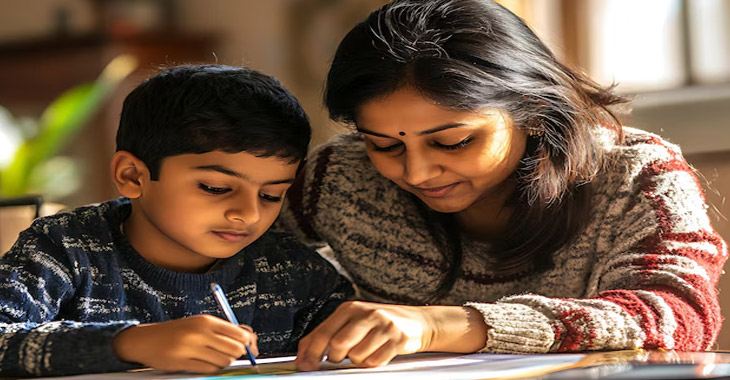
Indian parents homeschooling their kids at home
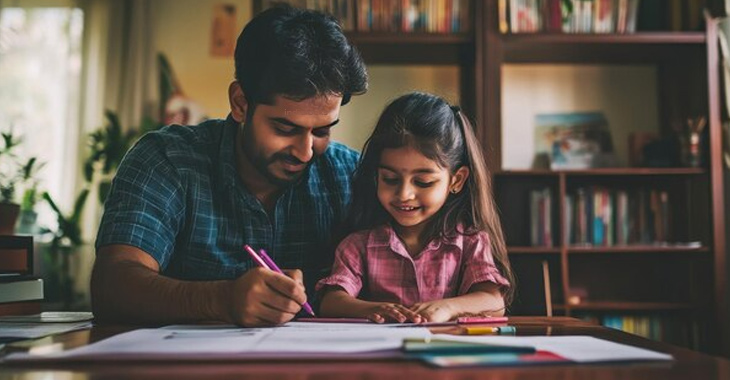
Homeschooling represents an alternative education model where parents or guardians assume the primary role of educating their children at home, rather than enrolling them in a conventional school.
Imagine being a kid again. You awaken not to the sound of your parents yelling that you’re late for school, but simply when your body feels ready. There’s no tired battle to get out of bed. No hurried preparations. Instead, you rise feeling refreshed, with your natural sleep cycle guiding you.
After getting up, you aren’t bound to a strict school schedule. You might spend a few years diving deep into study if necessary, or start your day engaging in activities you genuinely enjoy, such as playing sports, learning music, or creating art.
It sounds like a fantasy, doesn’t it? Surprisingly, this scenario is a reality for many children, even in India, whose parents have opted for home education.
Whether you call it homeschooling or unschooling, it is increasingly becoming a unique method for parents to educate their children, covering not only academic subjects like science, math, and English but also essential life skills.
Why choose unschooling?
Parents who decide to homeschool often have diverse motivations that lead them down this unconventional path. While their reasons differ, common themes emerge, such as a desire for their children to avoid a rigid schedule and to have the freedom to pursue interests that extend beyond traditional academics.
How do children learn in a homeschooling setup?
If you’re curious about how these children actually gain knowledge, the response is not simple. Like parenting, homeschooling and unschooling differ from one family to another, based on individual preferences for how their children should learn.
Who is their target audience?
The focus is on parents who are Non-Resident Indians (NRIs) wanting their children to receive an Indian education, those with jobs that require relocation, and families whose children prefer to prioritize extracurricular activities over standard academics.
What are the challenges of homeschooling?
Though homeschooling may seem like an ideal situation for parents and kids alike, it presents its own unique challenges.
In our rapidly changing world, families often face difficulties related to both time and financial limitations. Not every parent can create an organized learning atmosphere or invest enough time into their child’s education.
As homeschooling significantly depends on learning from one’s surroundings, children in less interactive environments, such as busy metro areas with limited community interactions, might not thrive as well. This educational approach can indeed be isolating for children.
Homeschooling families typically attempt to counteract this by enrolling their kids in various extracurricular activities.
Nonetheless, replicating the dynamic environment of a traditional school, where children spend extensive hours engaging independently with their peers, as opposed to shorter focused classes, can be challenging.
Homeschooling is indeed legal in India. Historically, before the rise of modern educational institutions, Indian education was predominantly personal, often commencing at home under the tutelage of a guru.
This tradition embraced more than mere academics, promoting both personal and spiritual development. The gurukul system later introduced a collaborative approach to learning, still focused on holistic growth rather than strictly structured classroom education.
From a legal standpoint, homeschooling is allowed in India. The Right to Education (RTE) Act of 2009 requires free and compulsory education for children aged 6 to 14 but does not specifically mention that such education must occur within a traditional school environment.
This means that parents can educate their children at home without breaking any laws. Although there is no specific regulatory authority overseeing homeschooling in India, families can pursue distance learning programs through recognized institutions to secure valid certifications.
Furthermore, in the wake of the pandemic, the Ministry of Education introduced ePathshala, an online learning platform that provides digital educational materials.
Overall, homeschooling is becoming a distinctive and innovative approach to education. Although it is well-established in Western countries, it is still a relatively new concept in India.